AI agent vs chatbot: the three generations, explained
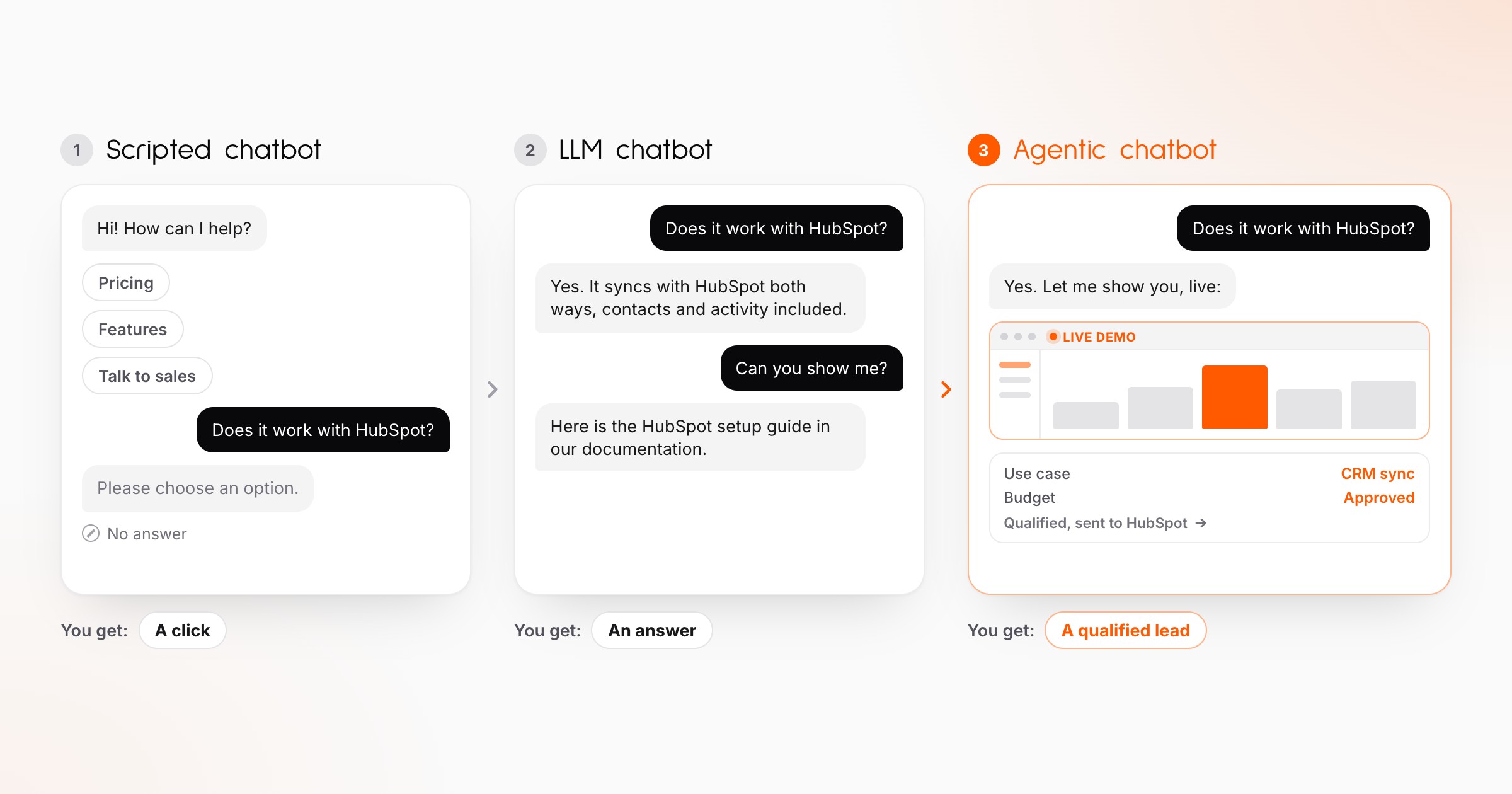
In short
A chatbot answers: the first ones offered scripted buttons, the LLM ones understand plain language and answer from your knowledge base. The third generation, the agentic chatbot, is an AI agent in chat form: agents behind it also show the product, qualify the visitor and log the conversation in your CRM.
Nodale is an AI agent turning inbound into hot leads: B2B website visitors get answers and a live demo, 24/7 in 50+ languages, and share their intent, use case and budget, so companies convert more of the traffic they already pay for.
What is the difference between an AI agent and a chatbot?
A chatbot answers. An AI agent can take the form of a chatbot on your website, which is why we call it an agentic chatbot: behind the chat, several agents do other jobs. They show the product, qualify the visitor, understand why they came and log the conversation in the CRM. Chatbots went through three generations to get there.
| Scripted chatbot | LLM chatbot | Agentic chatbot (AI agent) | |
|---|---|---|---|
| How it answers | Predefined buttons | In plain language, from your knowledge base | The same, and it acts |
| A question outside the script | No answer | Answered | Answered |
| Shows the product | No | Not its job | Yes, in a live demo |
| Qualifies on your criteria | Through fixed choices | Not its job | Yes, during the conversation |
| Logs the conversation in your CRM | No | Not its job | Yes, with the next step |
| Built for | Routing simple requests | Answering | Turning a visit into a qualified lead |
What was the first generation of chatbots?
The scripted chatbot we have all met. It offers predefined answers: you click A, B or C, and it sends you to A’, B’ or C’. If your question is precise and does not fit the boxes, you never get your answer.
What changed with LLM chatbots?
They understand the question. An LLM chatbot runs on a large language model connected to your knowledge base: the visitor writes in their own words, and it answers from what your company knows. It is clearly much better, and on a website it feels like the same chat experience as an agent.
For support, that is the job. Your customers have a question, and an LLM chatbot helps them, right away.
What makes an agentic chatbot different from an LLM chatbot?
What happens behind the chat. An agentic chatbot is an AI agent in chat form, with agents behind it that do more than answer:
- it shows the product, in a live demo, when showing is the best answer;
- it qualifies the visitor on your criteria, during the conversation;
- it understands why the visitor came;
- it logs the conversation in your CRM, with the next step.
The visitor sees one conversation. Your sales team gets a qualified lead with its context.
Why does a sales use case need an agent?
Because the goal is not the answer, it is revenue. A marketing or sales tool gives answers because answers help a visitor convert, but its job is to qualify and to convert. A tool built to answer stops when the question is answered.
Why does the visitor share use case and budget with an agent?
Because the agent gave something first. The visitor got answers and saw the product, so the exchange lasts longer, and the visitor shares what a chatbot or a form rarely gets: why they came, their use case, their budget. That is also why an AI agent next to the form converts more than the contact form alone.
With Nodale, what the visitor shares goes to your sales team in HubSpot, synced both ways: why they came, what they asked, what they were shown, and the next step.
When is a chatbot enough?
When the job is support. An LLM chatbot connected to your knowledge base is enough to answer your customers, and for me, that is where it stops. As soon as the use case is sales (showing the product, qualifying, handing a lead to a rep with its context), you need an agentic chatbot. The scripted chatbot belongs to another era: it answers only what someone wrote in advance.
Frequently asked questions
Is an AI agent a chatbot?
It can take the form of one, the agentic chatbot: the visitor writes or talks to it on your website. Behind it, several agents do more than answer: they show the product, qualify, and hand the lead to your sales team with its context.
Does the visitor have to talk out loud?
No. The visitor chooses voice or text, 24/7, in 50+ languages.
Which CRM does Nodale work with?
HubSpot, synced both ways: the conversation, the qualification answers and the next step arrive on the contact.
What does the sales team still do?
Everything that needs a person. The agent prepares the ground. Your rep convinces, negotiates and signs.